
Professor Eval Bladimir Bacca Cortes, a researcher at the Perception and Intelligent Systems Research Group (PSI) at the School of Electrical and Electronic Engineering (EIEE), said the vast majority of devices available to help the blind navigate the world right now are very expensive, with many useful features coming at an extra cost.
"Current business solutions that require high-priced smartphones are not safe or street-ready," Professor Bacca said, adding that the GlobalViewAid prototype would be designed with visual sensors and processors small enough to fit in a baseball cap.
Additionally, up to 87% of the development and production of biomedical devices in 2012 was in high-income countries and most are designed for this context.
Professor Bacca explained that today, the typical price of a device is $10,000 USD (40 million Colombian pesos).
"One of the reasons for this high cost is that companies have to pay for years of research and development... Our goal as researchers is to come up with a product that would cost $1,500 per unit," Professor Bacca said, adding that the idea is to assume lower research and development costs, and offer the prototype directly to foundations or governments that will be able to distribute the technology to the people who need it.
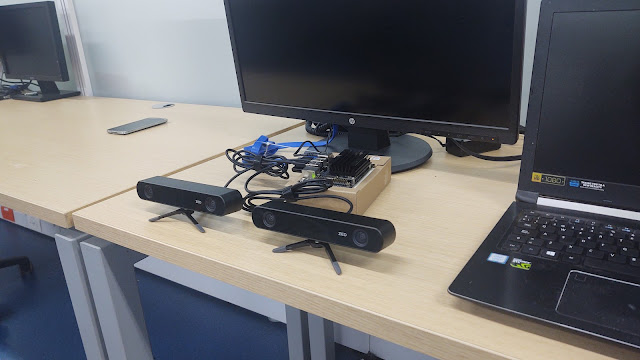
Stereo cameras and a processing unit that are part of the GlobalViewAid project. Credit: Andrew James/NCC-FI/Univalle.
Jhon Kevin Muñoz Peña, Electronic Engineer/Researcher at Univalle, said that a great difficulty in this project is to take into account all the different scenarios that a user might find in their daily life in Colombia.
Read more about the School of Electrical and Electronic Engineering: Colombian engineers working on exoskeletons to help patients relearn how to walk.
How does it work?
In his laboratory in Cali, Colombia, Professor Bacca showed how the technology that will be implemented when the prototype is deployed in the real world.
On the desk are two stereo cameras, and the image processing unit: the lenses of each camera are approximately the same distance apart as human eyes.
"The idea is to provide a field of vision and depth perception very similar to that of a person," Professor Bacca explained.
Next, the researcher showed how the sensor works: on a computer screen, the darker parts of the image represent closer distances and the lighter parts of the image represent farther distances.
"This is just the information input... then the software, after analyzing the images, will convert the obstacle alerts around the person into an audio instruction," Professor Bacca said, adding that, for example, the device can inform the user that “Within 4 meters, there is a branch in your way.”
“Today, a person with visual disability can use a cane but this only covers the area immediately in front of the person… the idea with the prototype under development is that a person can plan their path and know in advance all the dangers in front of them. the route using audio alerts,” Professor Bacca explained.
Jhon Kevin Muñoz Peña, Electronic Engineer/Researcher at Univalle, said that a great difficulty in this project is to take into account all the different scenarios that a user might find in their daily life in Colombia.
"The goal is to finish the prototype by September 2022, and start testing it at the Institute for Blind and Deaf Children here in Cali," Muñoz said.
Muñoz stated that the project also has undergraduate students working on projects to detect obstacles at different heights.
"At each height there are different obstacles, such as branches or furniture... We also have other students focused on support applications to identify Colombian money, and thus distinguish between different denominations," Muñoz explained.
 |
| Image: A representation of the information captured by the stereo cameras. Credit: Juan Bacca/NCC-FI/Univalle |
The Internacional Picture and The Swiss Connection
Dr. Mario Chavarria, global director of the GlobalViewAid project, a leader in technology development and an engineer from Caleño, explained that in 2019, the EssentialTech Center of the Federal Polytechnic School of Lausanne (EPFL) in Switzerland, with the collaboration of engineers and social researchers from the University of Geneva (Switzerland), the Universidad Autónoma de Occidente (UAO) and Univalle in Colombia, conducted an exploratory study in Colombia to better understand the technologies available for the blind in the local market, as well as the users' requirements, needs and desires.In 2020, the Gelbert Foundation of Switzerland decided to sponsor the first stage of technological development of the project, which started in 2021.
Dr. Chavarria stated that both the UAO and Univalle are recognized for the quality of their research and technological developments, with a strong social focus, and had successful research experiences with them in the past.
“In the particular case of the PSI group at Univalle, in addition to having a strong knowledge in A.I., they had already developed assistive technologies for blind users in the past and are familiar with the needs and constraints of the Colombian context.,” dijo el profesor Chavarria.
Dr. Chavarria stated that both the UAO and Univalle are recognized for the quality of their research and technological developments, with a strong social focus, and had successful research experiences with them in the past.
Professor Bacca stated that he is very proud of the collaborative and multidisciplinary environment that they developed in the School of Electrical and Electronics of the Faculty of Engineering at Univalle.
"There is a link between the quality of the work environment, the quality of work and the students," said the professor, adding that students have brought an image of professionalism to institutions around the world.
Comentarios
Publicar un comentario