
Tidal energy is already an abundant renewable resource used in the United Kingdom, Australia, and South Korea—but now researchers at the Universidad del Valle (Univalle) want to use this energy technology to give new opportunities to communities in the central Pacific coast of Colombia.
The potential global market for tidal energy, i.e. energy derived from ocean tides, is 150 to 800 TWh (terawatt hours) per year, with a market value of up to 40,000 million euros per year, according to a 2020 European Union report.
Juan Gabriel Rueda Bayona, a professor at the School of Natural Resources and Environmental Engineering, EIDENAR, at the Universidad del Valle (Univalle) said Colombia's Pacific region has the potential to implement microturbines in strategic areas with the challenge of optimizing them to extract energy from the local tide whose heights are up to 4 meters and current speeds of up to 1.5 meters per second.
Before his recent arrival at Univalle, Professor Rueda previously conducted studies that were published in the scientific journal INGE CUC: "Tidal Energy Potential in the Center Zone of the Colombian Pacific Coast". In this article, the professor and his co-author studied four locations in Colombia's central Pacific, and found that Buenaventura registered the highest cumulative potential for electricity generation (31,546.56 watt hours per month).
"Although we identified areas with potential, there is much more work to be done before we can build a pilot plant," said Professor Rueda, adding that further studies will explore the environmental and socioeconomic impacts of tidal energy in the region.
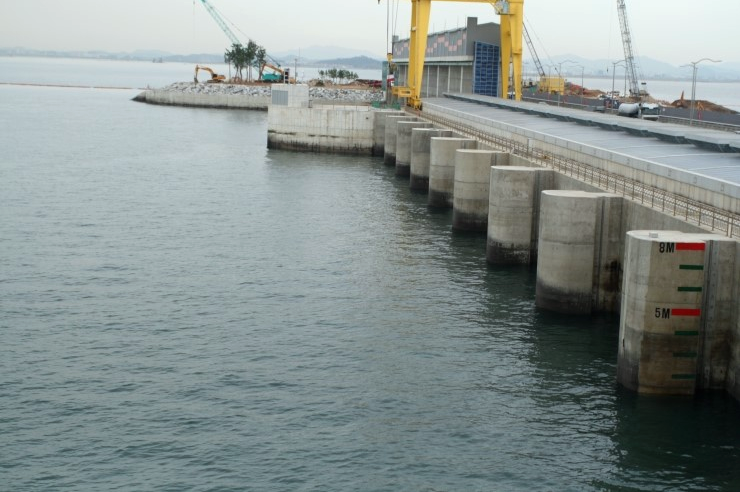
Photo: "File:Sihwa Lake Tidal Power Station 01.png" Credit: 핑크로즈 is licensed under CC BY 2.0.
Towards a Better Energy Source
Professor Rueda explained that there are two common tidal energy systems.
The first, a tidal barrage power system, takes advantage of the differences between high and low tides by blocking the receding water during ebb periods, a phenomenon where the seawater recedes with the change of the tide. At low tide, the water behind the dike is released and passes through a turbine that generates electricity.
Tidal energy systems, on the other hand, can take the form of tidal turbines, which resemble underwater wind turbines.
He explained that there are important conditions that make the Pacific coast an ideal area for the study and implementation of tidal energy: the height of the tides; the speed of the tidal currents; the low times of minimum currents (between 1-2 hours); and the depths suitable for marine energy projects.
In the study, they conducted a literature review of national and international experiences related to tidal energy; characterized it from tidal heights and made calculations of energy potentials from tidal currents of the Colombian Pacific derived from hydrodynamic models (Delft3D) validated with data measured on site.
"It should be noted that the models and simulations of this research were carried out in the month of September where maximum wind speeds are present, which generates a reduction in current speeds during the lowest tides, thus having a higher degree of reliability in the generation of energy under adverse conditions," Quintero said.
Quintero added that there are challenges and opportunities for communities on the Pacific coast to take advantage of the potential of marine energy.
"The greatest opportunity that the communities have is to have a service that is essential for a dignified life, a source of energy generation that is supplied in areas with greater difficulty of access to the network, which is clean to reduce the effect of greenhouse gases (GHG) that occur by burning fossil fuels and vegetable-based fuels," Quintero said.
Read more from EIDENAR: Mining Waste Can Carry Out Cleaner Combustion
El profesor Rueda explicó que por medio de las lluvias fuertes, otras fuentes renovables no son aptas, por ejemplo la energía de paneles solares.
“La marea viene dos veces al día: la energía mareomotriz puede funcionar cuando el sol no brilla y el viento no sopla”, manifestó el profesor Rueda, añadiendo que la energía de mareomotriz necesita almacenamiento, pero esto podría conducir a la producción de hidrógeno verde.
El sitio que parece lo más indicado para la energía mareomotriz, la ciudad de Buenaventura, tiene una población donde 82% de las personas se encuentra en un estado de pobreza extrema.
La energía mareomotriz también cumplirá con el Objetivos de Desarrollo Sostenible de la ONU “ODS 7”, que tiene que ver con la energía asequible y no contaminante.
“La esperanza es que la mareomotriz pueda generar no solamente energía marina sino también servir como una nueva fuente de empleo”, manifestó el profesor Rueda, añadiendo que la producción de hidrógeno puede servir como la base de una economía local basada en el uso de hidrógeno en vez de los combustibles fósiles.
Para beneficiar a la comunidad
Se estima que el 20% de las viviendas ubicadas en el Pacífico colombiano pertenecen a Zonas No Interconectadas (ZNI) a la red eléctrica y dependen en energía que viene desde combustibles fósiles, que pueden ser costosas y perjudiciales para la salud. Los investigadores dicen que esta investigación genera conocimiento para la diversificación de la matriz energética colombiana, y la reducción de las limitaciones de acceso a la energía para aquellas comunidades sin acceso a la red nacional de distribución de energía, con una propuesta de ingeniería que busca mejorar las condiciones socioeconómicas de las comunidades vulnerables de la ciudad de Buenaventura, el puerto más grande de la costa pacífica colombiana.El profesor Rueda explicó que por medio de las lluvias fuertes, otras fuentes renovables no son aptas, por ejemplo la energía de paneles solares.
“La marea viene dos veces al día: la energía mareomotriz puede funcionar cuando el sol no brilla y el viento no sopla”, manifestó el profesor Rueda, añadiendo que la energía de mareomotriz necesita almacenamiento, pero esto podría conducir a la producción de hidrógeno verde.
El sitio que parece lo más indicado para la energía mareomotriz, la ciudad de Buenaventura, tiene una población donde 82% de las personas se encuentra en un estado de pobreza extrema.
La energía mareomotriz también cumplirá con el Objetivos de Desarrollo Sostenible de la ONU “ODS 7”, que tiene que ver con la energía asequible y no contaminante.
“La esperanza es que la mareomotriz pueda generar no solamente energía marina sino también servir como una nueva fuente de empleo”, manifestó el profesor Rueda, añadiendo que la producción de hidrógeno puede servir como la base de una economía local basada en el uso de hidrógeno en vez de los combustibles fósiles.
Comentarios
Publicar un comentario